How the Workforce Risk & Readiness Diagnostic Works
How It Works
Stage 1: Intake & Validation (Weeks 1–2)
We review your existing workforce data to establish scope, validate inputs, and identify material gaps.
Focus:
Workforce structure
Mission-critical roles
Data completeness and limitations
No assumptions are made. Missing data is documented, not inferred.
Stage 2: Normalization & Analysis (Weeks 3–5)
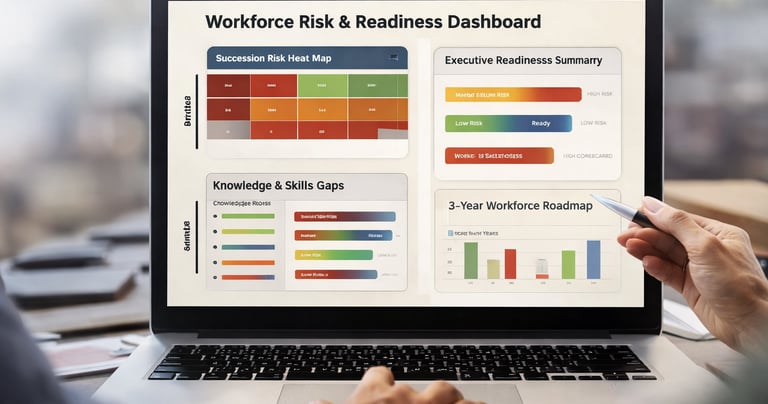
Data is standardized and analyzed using a structured diagnostic framework to assess:
Succession exposure
Leadership and role vulnerability
Skills and knowledge concentration
Workforce readiness over a 1–3 year horizon
All findings are evidence-linked and confidence-rated.
Stage 3: Delivery & Briefing (Weeks 6–8)
You receive a decision-grade report and executive-level briefing focused on:
What is at risk
Why it matters
What to address first
Outputs are designed to support leadership action, budgeting, and contracting decisions.
What This Diagnostic Is
The Workforce Risk & Readiness Diagnostic is a fixed-scope, evidence-based assessment designed to give leaders a clear, defensible view of workforce risk before it disrupts mission delivery.
It is not a survey, not software, and not an open-ended consulting engagement.
It uses workforce data you already maintain to surface succession exposure, role vulnerability, skills risk, and readiness gaps—quickly and objectively.
This diagnostic also serves as the foundation for optional human capital consulting, implementation support, and long-term workforce strategy engagements when required.

What We Need From You to Get Started
Required inputs
Workforce roster (CSV or Excel)
Organizational chart (any format)
Brief description of mission priorities
Optional inputs (strengthen results)
Skills or training exports
Known retirements (1–3 year horizon)
Succession coverage notes
Position descriptions or task lists
AI / data governance constraints
No system access. No integrations. No disruption to operations.
What Happens After the Diagnostic
The diagnostic stands on its own and is frequently used to:
Inform internal workforce decisions
Support budget or staffing requests
Provide evidence for leadership or board briefings
When requested, findings can transition into contracted human capital consulting, including:
Succession planning and bench development
Workforce modernization support
Skills strategy and implementation roadmaps
Policy, governance, or compliance alignment
Consulting is optional, scoped separately, and driven by diagnostic evidence—not assumptions.
Workforce Diagnostics LLC
Evidence-based workforce diagnostics and human capital consulting for federal, state, and regulated organizations.
Address
1116 Fairfax Blvd Ste 500
Fairfax, VA 22030
Phone
703-596-8245
© 2026 Workforce Diagnostics LLC. All rights reserved. Terms I Conditions I Privacy Policy.